

THE NEXT DIGITAL WAR HAS ALREADY BEGUN — IS INDIA'S FINANCIAL SYSTEM PREPARED?
AI-Powered Cybercrime Is Scaling Faster Than Human Defenses
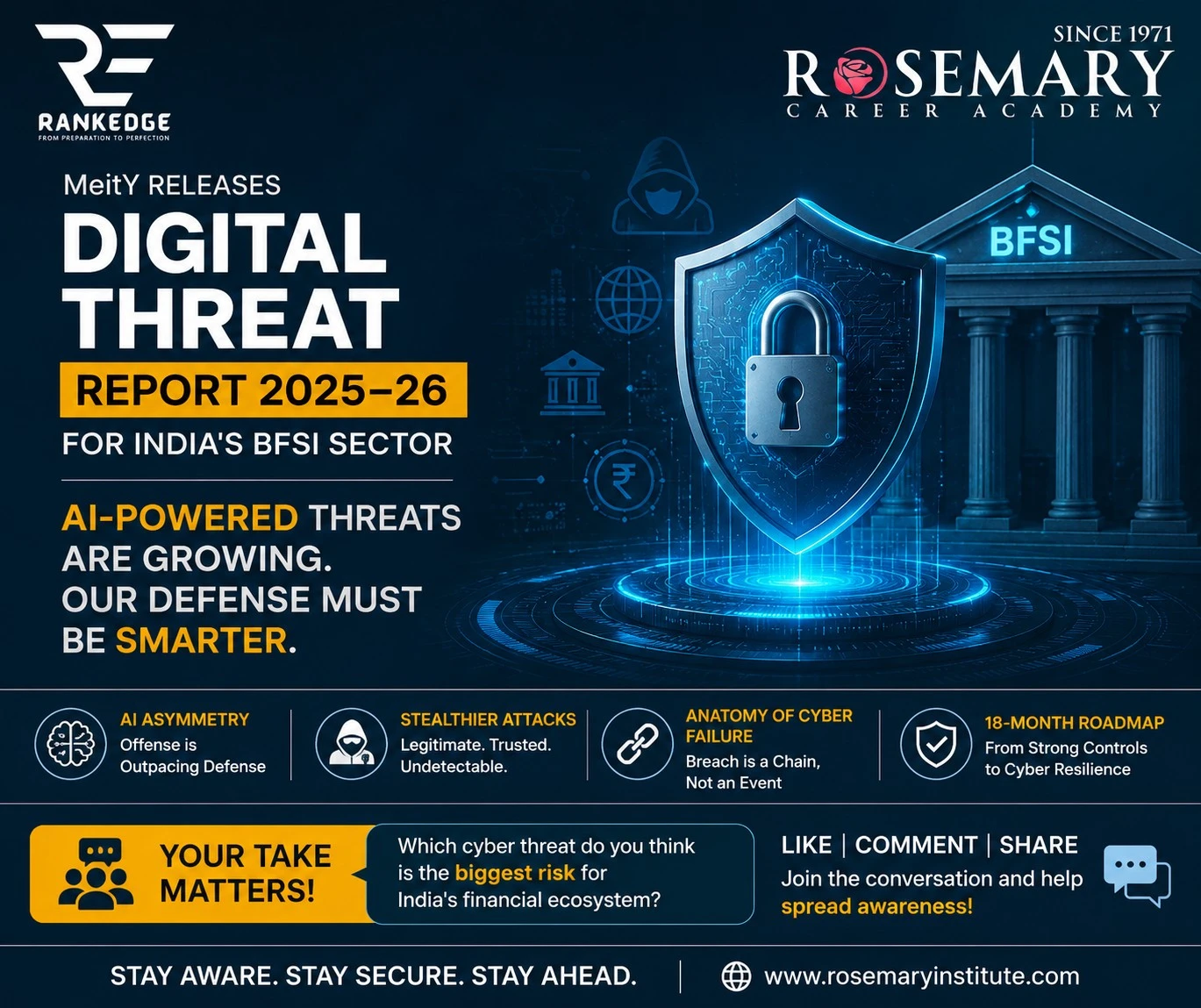
The Rules of Cybersecurity Have Changed Forever
Artificial Intelligence is no longer just improving productivity—it is transforming cyber warfare.
India's Ministry of Electronics & Information Technology (MeitY), in collaboration with CERT-In, CSIRT-Fin and SISA, has released the Digital Threat Report 2025–26, presenting a clear warning:
Cyber attacks are becoming faster, smarter, automated, and increasingly difficult to detect.
For students preparing for competitive examinations, technology professionals, banking aspirants, cybersecurity enthusiasts, and business leaders, this report is not merely another government publication.
It is a roadmap of the future.
The future belongs to those who understand digital security.
AI Has Created an Unequal Battlefield
Traditionally, launching a sophisticated cyber attack required:
- Highly skilled hackers
- Large financial resources
- Months of planning
- Technical infrastructure
Today?
Generative AI has dramatically reduced these barriers.
An attacker with limited technical expertise can now:
- Generate phishing emails within seconds
- Create convincing fake identities
- Automate malware generation
- Write malicious scripts using AI assistants
- Launch large-scale attacks at machine speed
Meanwhile, organizations still rely on:
- Manual monitoring
- Periodic security audits
- Human approvals
- Legacy security frameworks
This growing gap is described in the report as AI Asymmetry—where offensive capabilities evolve faster than defensive systems.
This is perhaps the most significant cybersecurity challenge of the decade.
Cybercriminals No Longer Hack Systems...
They Hack Human Trust.
The report identifies a major shift.
Earlier cyber attacks looked like obvious intrusions.
Today's attacks appear completely legitimate.
Examples include:
- Genuine-looking login sessions
- Approved payment requests
- Authentic employee credentials
- Trusted cloud applications
- Regular business workflows
By the time an organization realizes something is wrong...
The money is gone.
The data has already been stolen.
The damage has already been done.
Modern cybercrime focuses less on breaking systems and more on exploiting trust.
The Speed of Cybercrime Is Accelerating
One of the report's most alarming observations is that:
Six out of the seven future predictions made in last year's report have already become reality.
Threat evolution that once took years now happens within months—or even weeks.
This means organizations cannot depend on reactive security anymore.
Cybersecurity must become predictive.
The Biggest Threats Facing BFSI in 2026
According to the report, financial institutions now face increasingly sophisticated attacks involving:
Social Engineering
Manipulating people into revealing sensitive information.
Credential Theft
Stealing usernames, passwords, authentication tokens and digital identities.
Supply Chain Attacks
Compromising trusted vendors to infiltrate larger organizations.
Cloud Exploitation
Targeting cloud-based infrastructure where critical financial services now operate.
AI-Assisted Fraud
Using artificial intelligence to automate phishing, fraud detection evasion and malicious content generation.
These are no longer "emerging risks."
They are active realities.
Every Cyber Breach Is Actually a Chain Reaction
One of the most valuable contributions of the report is its concept of the:
Anatomy of Cyber Failure
Instead of blaming a single mistake, the report explains that successful cyber attacks usually result from multiple small failures occurring together.
Examples include:
- Weak identity verification
- Delayed software updates
- Poor employee awareness
- Inadequate monitoring
- Cloud configuration errors
- Third-party vulnerabilities
When combined, these seemingly minor gaps create opportunities for catastrophic breaches.
Organizations must therefore strengthen entire security ecosystems—not just individual technologies.
Cybersecurity Is No Longer an IT Department Problem
Perhaps the strongest message throughout the report is this:
Cybersecurity is now a business strategy.
Banks.
Insurance companies.
FinTech firms.
Payment platforms.
Government institutions.
Every organization that stores digital information must treat cyber resilience as a leadership responsibility rather than a technical function.
Security decisions now influence:
- Customer trust
- Business continuity
- Brand reputation
- Financial stability
- Regulatory compliance
- National digital resilience
The Skills Employers Will Soon Demand
For students and professionals planning careers, this report offers another important insight.
Demand will continue to rise for expertise in:
- Cybersecurity
- Ethical Hacking
- AI Security
- Cloud Security
- Digital Forensics
- Threat Intelligence
- Risk Management
- Governance, Risk & Compliance (GRC)
- SOC Operations
- Incident Response
These are rapidly becoming some of the most future-proof career paths in the digital economy.
What Every Student Should Learn Today
Whether you aspire to become:
- An IAS Officer
- A Banker
- A Software Engineer
- A Data Scientist
- A Cybersecurity Analyst
- A FinTech Entrepreneur
Digital security literacy is no longer optional.
Understanding cyber threats is becoming as essential as understanding finance, communication or technology itself.
The professionals who combine AI knowledge with cybersecurity expertise will shape the next generation of India's digital economy.
Final Thoughts
The Digital Threat Report 2025–26 is more than a cybersecurity assessment.
It is a warning.
Artificial Intelligence is changing the economics of cybercrime.
Organizations can no longer rely on yesterday's security strategies to defend tomorrow's threats.
The question is no longer:
"Will cyber attacks happen?"
The real question is:
"How prepared are we when they do?"
India's digital future depends not only on innovation—but also on resilience.
The institutions, professionals, and students who invest in cybersecurity knowledge today will become the guardians of tomorrow's digital economy.
About RANKEDGE – Rosemary Career Academy
At RANKEDGE, we prepare future-ready learners for careers in government services, banking, defence, technology, and the digital economy. Beyond exam preparation, we focus on building awareness of emerging technologies, AI, cybersecurity, and industry trends that will define tomorrow's workforce.
🌐 Website: www.rosemaryinstitute.com