

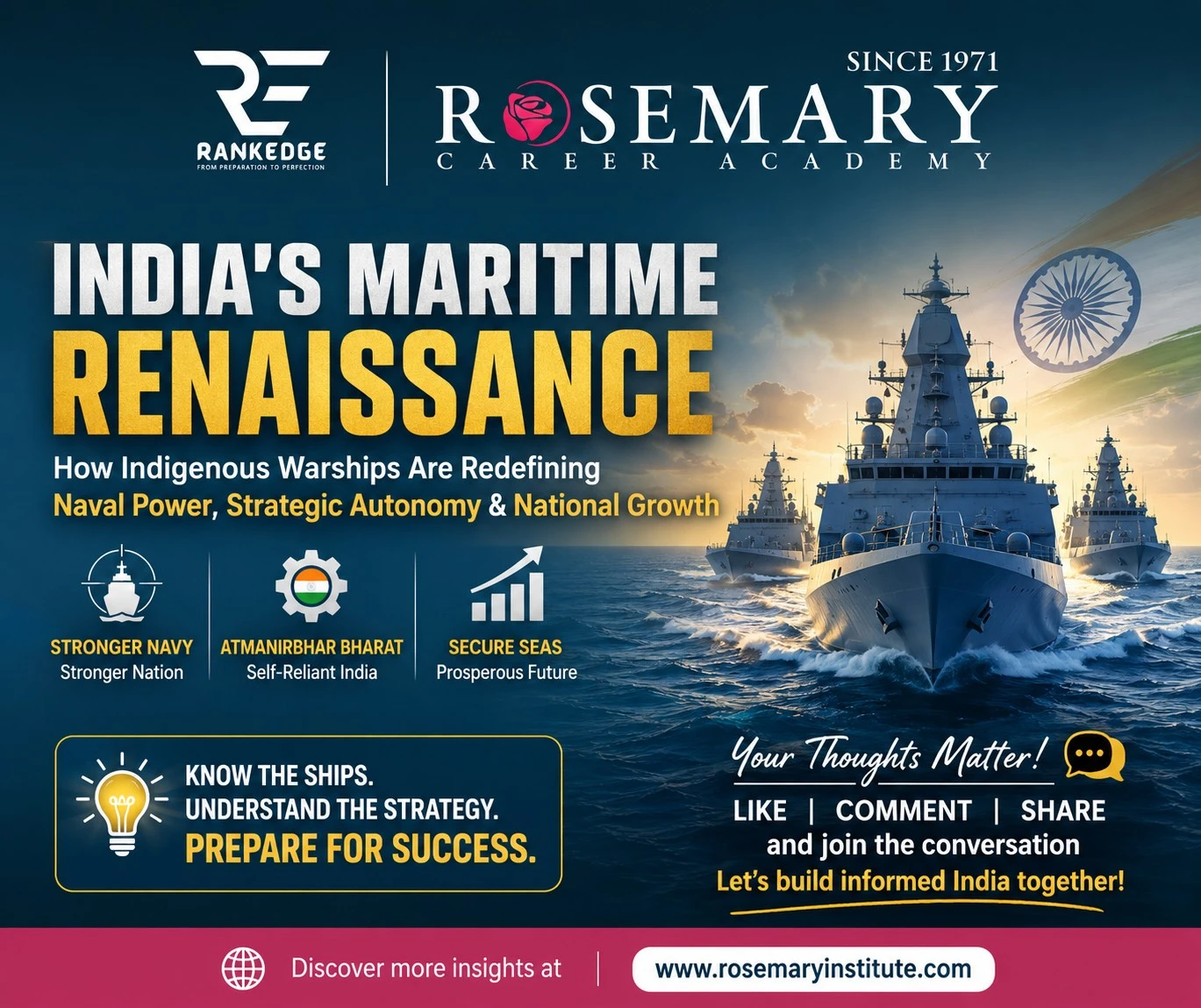
India's Maritime Renaissance: How Indigenous Warships Are Redefining Naval Power, Strategic Autonomy & National Growth
Why Maritime Security Matters for India
India enjoys a unique geographical advantage.
Located at the heart of the Indian Ocean, the country oversees some of the world's busiest maritime trade routes.
The Indian Navy safeguards:
- Approximately 11,098 km of coastline
- Nearly 2.4 million sq. km Exclusive Economic Zone (EEZ)
- Sea lanes carrying almost 90% of India's trade by volume
- Offshore energy infrastructure
- Strategic maritime assets
- Regional peace and stability across the Indian Ocean Region
Any disruption in these waters directly affects India's economy, energy security, international trade, and geopolitical influence.
↑ Back to TopIndia's Three-Layer Maritime Defence Strategy
Modern naval warfare requires specialized platforms rather than one ship performing every role.
India has adopted a layered maritime defence architecture, with each indigenous class of warship serving a distinct strategic purpose.
These include:
- Nilgiri-Class Stealth Frigates
- Sandhayak-Class Survey Vessels
- Arnala-Class Anti-Submarine Warfare Shallow Water Crafts
Together, these platforms provide comprehensive protection across the surface, underwater, and coastal domains.
↑ Back to Top1. Nilgiri-Class Stealth Frigates
India's Frontline Surface Combatants
The Nilgiri-Class, developed under Project 17A, represents India's latest generation of stealth-guided missile frigates.
These warships are designed for modern multi-domain warfare and are capable of simultaneously performing:
- Anti-Air Warfare
- Anti-Surface Warfare
- Anti-Submarine Warfare
- Fleet Protection
- Maritime Strike Operations
Unlike conventional warships, stealth frigates minimize their radar, thermal, and acoustic signatures, making them much harder for enemy surveillance systems to detect.
Technical Highlights
- Length: Approximately 149 metres
- Displacement: Around 6,670 tonnes
- Speed: 28 knots
- CODOG (Combined Diesel or Gas) propulsion
- BrahMos supersonic cruise missiles
- Advanced Medium-Range Surface-to-Air Missiles
- Hull-mounted sonar
- Integrated helicopter operations
The Project 17A programme consists of seven indigenous stealth frigates, reflecting India's growing capability in advanced warship design and construction.
↑ Back to TopUnderstanding Stealth Technology
One common misconception is that stealth technology makes a warship invisible.
In reality, stealth technology dramatically reduces the probability of detection.
Modern stealth ships achieve this through:
- Angled surfaces that deflect radar waves
- Radar-absorbing materials
- Reduced infrared signatures
- Lower acoustic noise
- Advanced heat management systems
The result is improved survivability and greater tactical advantage during combat operations.
↑ Back to Top2. Sandhayak-Class Survey Vessels
Mapping the Ocean Before Protecting It
A modern navy depends not only on weapons but also on information.
Survey vessels provide the hydrographic intelligence required for:
- Safe navigation
- Port development
- Coastal infrastructure
- Naval operations
- Commercial shipping
- Disaster response
- Blue Economy initiatives
The Sandhayak-Class Survey Vessels strengthen India's maritime domain awareness by mapping seabeds, producing nautical charts, and collecting oceanographic data.
Key Specifications
- Length: Around 110 metres
- Displacement: 3,400 tonnes
- Range: 6,500 nautical miles
- Crew: Approximately 178 personnel
- Multi-beam echo sounders
- Side-scan sonar
- Autonomous Underwater Vehicles (AUVs)
- Hospital ship capability
Between 2019 and 2024, India's hydrographers surveyed approximately 89,000 square kilometres and produced 96 nautical charts, supporting both national and international maritime safety.
↑ Back to Top3. Arnala-Class Anti-Submarine Warfare Craft
India's Coastal Guardians
Submarines operating near coastlines pose unique challenges.
Large destroyers and frigates are often less effective in shallow waters.
The Arnala-Class Anti-Submarine Warfare Shallow Water Crafts are specifically designed for littoral operations.
Their primary missions include:
- Detecting hostile submarines
- Coastal surveillance
- Underwater warfare
- Mine warfare support
- Search and Rescue
- Humanitarian Assistance and Disaster Relief
Technical Specifications
- Length: 77.6 metres
- Displacement: Approximately 900 tonnes
- Waterjet propulsion
- Maximum speed: 25 knots
- Lightweight torpedoes
- Anti-submarine rockets
- Advanced shallow-water sonar
- Integrated combat management systems
These agile vessels allow larger warships to focus on blue-water operations while ensuring India's coastline remains secure.
↑ Back to TopAatmanirbhar Bharat in Action
Perhaps the most significant achievement is not just the commissioning of these vessels but where and how they are built.
These indigenous programmes demonstrate India's growing defence manufacturing capability.
Highlights include:
- Around 75% indigenous content in Project 17A frigates
- Over 80% indigenous content in Sandhayak-class survey vessels
- 64 out of 66 ships and submarines currently on order are being built in India
This significantly reduces dependence on foreign suppliers while strengthening India's strategic autonomy.
↑ Back to TopEconomic Impact Beyond Defence
The indigenous warship programme is also a powerful economic engine.
Employment Generation
Project 17A has:
- Supported more than 200 MSMEs
- Created around 4,000 direct jobs
- Generated over 10,000 indirect employment opportunities
Defence manufacturing is increasingly becoming a catalyst for industrial development and technological innovation.
↑ Back to TopStrengthening the Blue Economy
India's maritime strategy extends beyond defence.
Hydrographic surveys support:
- Fishing industries
- Offshore oil and gas
- Renewable ocean energy
- Port modernization
- Coastal infrastructure
- Maritime logistics
The Blue Economy currently contributes around 4% of India's GDP, making secure seas essential for long-term economic growth.
↑ Back to TopIndia's Growing Defence Exports
India is steadily transitioning from importing advanced defence equipment to exporting indigenous military platforms.
According to the backgrounder, national defence exports reached a record ₹23,622 crore during FY 2024–25, highlighting the increasing global competitiveness of India's defence industry.
↑ Back to TopWhy This Matters for Defence Aspirants
Whether you are preparing for:
- NDA
- CDS
- AFCAT
- CAPF
- UPSC Civil Services
- SSC
- State PCS
- Defence Interviews
Understanding India's indigenous defence capabilities is essential.
Topics frequently asked in competitive examinations include:
- Project 17A
- Nilgiri-Class Frigates
- Arnala-Class ASW Crafts
- Sandhayak-Class Survey Vessels
- Aatmanirbhar Bharat
- SAGAR & MAHASAGAR initiatives
- Blue Economy
- Indigenous Defence Manufacturing
Keeping track of such developments strengthens both current affairs and strategic awareness.
Read More | Latest Current Affairs | NDA Notes | CDS Notes | Current Affairs | Competitive Exams
↑ Back to TopConclusion
The commissioning of the Nilgiri, Sandhayak, and Arnala classes represents much more than naval modernization.
It reflects India's emergence as a nation capable of designing, engineering, and manufacturing sophisticated defence platforms that strengthen national security, generate employment, support economic growth, and enhance geopolitical influence.
As India expands its role in the Indo-Pacific, these indigenous warships will safeguard not only the nation's maritime frontiers but also its aspirations of becoming a leading global maritime power.
↑ Back to Top
RankEdge is the competitive examination vertical of Rosemary Career Academy, established in 1971. It provides structured preparation for NDA, CDS, AFCAT, CAPF, SSC, Banking, Railways, CUET, and other competitive examinations, combining expert mentorship, mock tests, current affairs, and concept-driven learning as part of Rosemary's broader educational ecosystem. (rosemaryinstitute.com)
Explore courses and educational resources: www.rosemaryinstitute.com
since 2018 US considered its military commands over indian-pacific region as USINDOPACOM. but in recent meetings US restored its USPACOM naming,
is it concerning for indias maritime influence or authority over indo-pacific region.
any opinion over this……..