
Puri Rath Yatra 2026: Complete Schedule, Rituals, Timings & Spiritual Significance
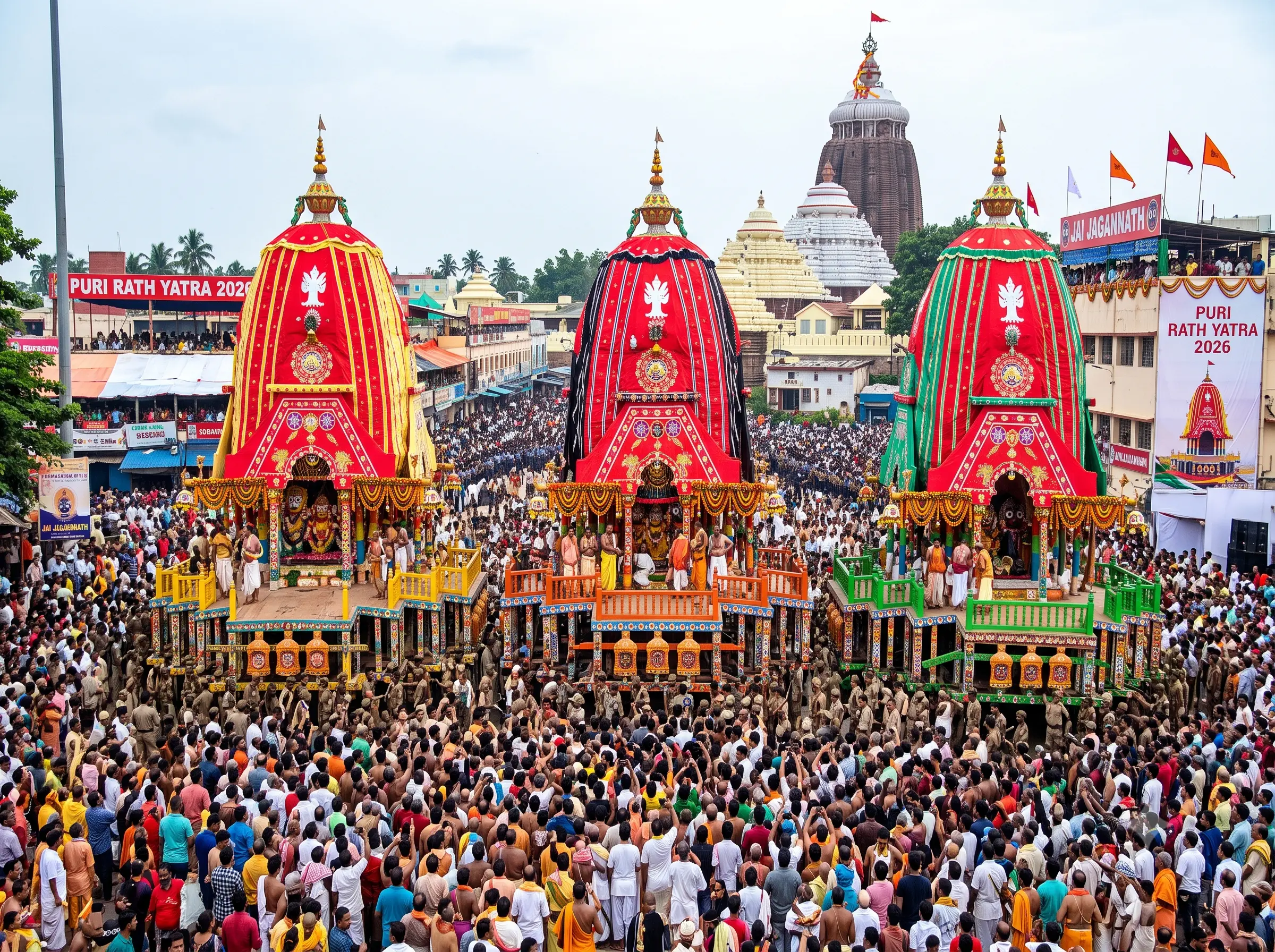
The grandest religious congregation of Odisha, the Puri Rath Yatra, is set to captivate the hearts of millions of devotees worldwide in 2026. This ancient annual Chariot Festival of Lord Jagannath, held in the holy seaside town of Puri, represents the pinnacle of spiritual surrender, communal harmony, and architectural genius. During this sacred period, the Lord of the Universe leaves His celestial temple to meet His devotees on the streets, marking a time of deep devotion, absolute equality, and divine bliss.
Puri Rath Yatra Schedule 2026
The schedules and precise timings of the Rath Yatra are formulated according to the Odia Hindu almanac (Panjika). To help you plan your spiritual pilgrimage or viewings, here is the official time table for the key rituals of the Puri Rath Yatra 2026, commencing on July 16, 2026.
| Time | Ritual | Description |
|---|---|---|
| July 15, 2026 08:30 PM |
Rath Pratishtha | The sacred consecration ceremony of the three massive wooden chariots by the royal temple priests. |
| July 16, 2026 09:30 AM |
Pahandi Bije | Ceremonial procession carrying Lord Balabhadra, Goddess Subhadra, and Lord Jagannath to their chariots. |
| July 16, 2026 02:00 PM |
Chhera Pahanra | The royal sweeping of chariot platforms by the Gajapati King of Puri with a golden broom. |
| July 16, 2026 04:00 PM |
Rath Tana | The grand chariot pulling begins, where millions drag the massive chariots towards the Gundicha Temple. |
| July 20, 2026 All Day |
Hera Panchami | Goddess Lakshmi visits the Gundicha temple in anger, searching for Lord Jagannath and damaging a chariot wheel. |
| July 24, 2026 09:00 AM |
Bahuda Yatra | The grand return journey of the deities back to the main Sri Mandir after their nine-day stay. |
| July 25, 2026 04:30 PM |
Suna Besha | The iconic ritual where the deities are decorated with massive golden ornaments on their chariots. |
| July 27, 2026 07:00 PM |
Niladri Bije | The deities return to the inner sanctum of the main temple, bringing the Rath Yatra to a sacred close. |
Rath Pratishtha (Consecration of Chariots)
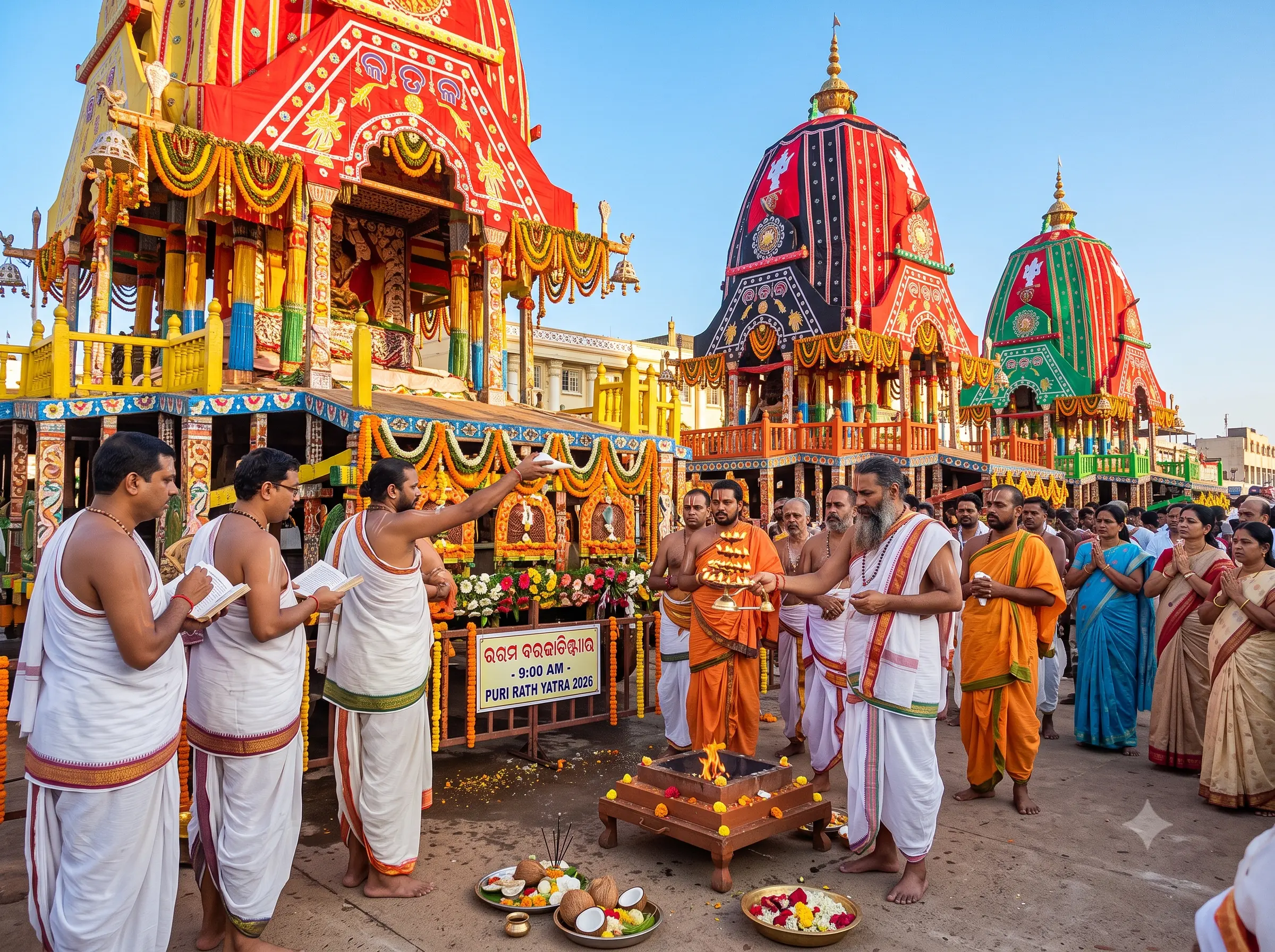
Before the deities cross the threshold of the Sri Mandir, the three towering chariots undergo a deep spiritual purification process. This ancient ritual, known as Rath Pratishtha, takes place a day before the main Chariot Pulling. It is conducted with the chanting of powerful Vedic hymns, rendering the wooden vehicles as mobile, living temples capable of holding the supreme cosmic energies of the cosmos.
Special yajnas are conducted by temple priests right in front of the grand chariots. The chief priests invoke the five elements—earth, water, fire, air, and space—into the wheels and axes of the structures. Holy water brought from sacred rivers is sprinkled across Nandighosha, Taladhwaja, and Darpadaliana to sanctify them, ensuring a safe and spiritually pure journey for the divine siblings.
- Invoking Deities: Involves invoking secondary deities, including the guardians of the eight cardinal directions (Ashta Lokapalas), into the chariot structures.
- Sacred Materials: Uses pure sandalwood paste, coconuts, organic leaves, and fresh flower garlands for purification.
- Royal Attendance: Witnessed by temple supervisors and administrative heads to certify structural and spiritual readiness.
Pahandi Bije (The Divine Procession)
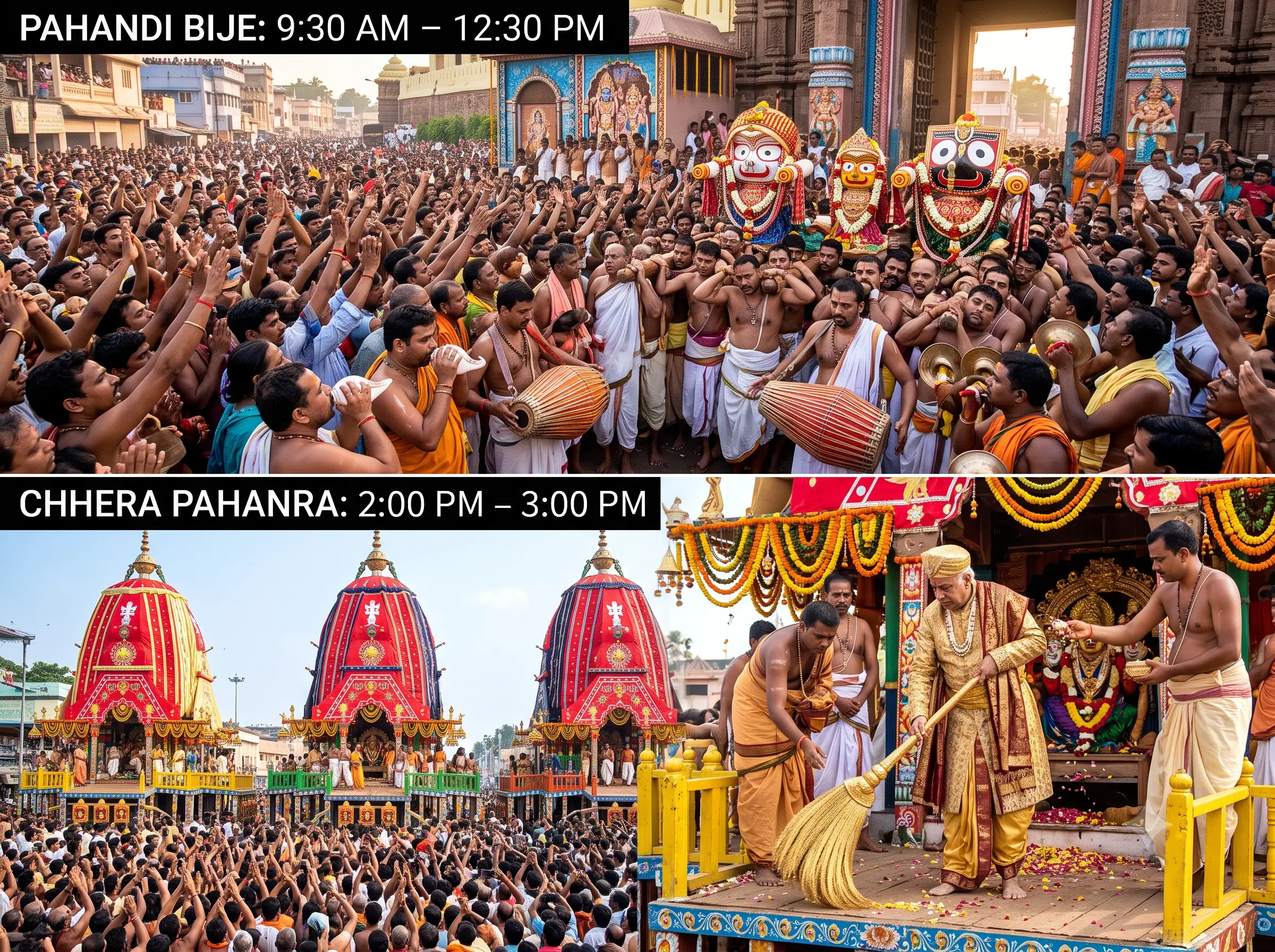
Pahandi Bije is arguably the most visually spectacular and emotionally charged ritual of the entire Rath Yatra. It is the ceremony where the deities are physically carried out of the temple sanctum sanctorum to the chariots. Millions of eyes fill with tears of devotion as Lord Balabhadra, followed by Goddess Subhadra and finally Lord Jagannath, sway forward in a rhythmic, undulating movement. The deities are adorned with large, heart-shaped floral crowns called "Tahias", which sway with every stride, creating a sight of divine intoxication.
The atmosphere is thick with the sound of thousands of clashing cymbals (manjiras), the deep resonance of traditional drums (mrdangas and khols), blowing conch shells, and the ecstatic shouts of "Jai Jagannath" echoing off the temple walls. Hundreds of powerful sevayats (temple custodians) form a human chain, slowly and lovingly guiding the colossal wooden deities down the 22 steps of the temple (Baisi Pahacha) and onto the Bada Danda, the Grand Avenue of Puri.
- Dhadi Pahandi: The deities move in a structured, sequential line, starting with Balabhadra, then Subhadra, and ending with Lord Jagannath.
- Tahiya Breaking: The heavy floral crowns (Tahias) are traditionally broken by eager devotees and sevayats once the deities reach their chariots, as these are considered highly sacred blessings.
- Sudarshana Lead: The celestial wheel, Sudarshana, is carried out first to lead the divine procession and clear any spiritual obstacles.
Chhera Pahanra (The Royal Sweeping)
Chhera Pahanra is a deep testament to the spirit of humility and equality of the Jagannath cult. After the three deities are safely installed on their respective chariots, the Gajapati King of Puri, who is considered the foremost servant (Adya Sevaka) of Lord Jagannath, arrives in a grand royal palanquin. Dressed in simple attire, the King ascends each chariot to perform the ritual of sweeping the wooden platforms.
Using a broom with a golden handle, the King sweeps the floors around the deities, sprinkling fragrant sandalwood water and pure camphor powder. This profound ritual demonstrates that before the supreme Lord of the Universe, there is no earthly king, emperor, or commoner. Everyone is a humble servant. This simple act of sweeping by a king has inspired millions of people across centuries, demonstrating that true leadership lies in selfless service and deep humility.
- Royal Humility: Demonstrates the absolute equality of all human beings in the eyes of the Divine.
- Golden Broom: The King uses a broom crafted with real gold filaments, which is kept exclusively for this annual ceremony.
- Twice Performed: This ritual is performed twice—first during the initial journey to Gundicha Temple, and again during the return Bahuda Yatra.
Rath Tana (Chariot Pulling)
Rath Tana marks the climax of the opening day of the festival. When the sweeping is complete and wooden horses are attached to the chariots, the massive ropes made of coconut fiber (coir) are uncoiled. On a single blow of the temple trumpet, millions of hands reach out to grasp the sacred ropes. Pulling the chariots is believed to wash away lifetimes of negative karma, granting instant spiritual liberation (Moksha) from the cycle of birth and death.
Lord Balabhadra's chariot, Taladhwaja, is pulled first, forging a path through the ocean of humanity. Next is Goddess Subhadra's Darpadaliana, and finally, amidst deafening cheers and intense waves of energy, Lord Jagannath's Nandighosha surges forward. Devotees pull with absolute strength, unaffected by the scorching summer heat or torrential monsoon rains, completely absorbed in the bliss of serving their Lord.
- Spiritual Liberation: Srimad Bhagavatam states that even catching a glimpse of the Lord on His chariot guarantees liberation from rebirth.
- Coir Ropes: The massive ropes are specifically woven from high-quality coconut fibers to withstand the pull of hundreds of thousands of people.
- Unifying Force: Transcends all distinctions of caste, creed, gender, and nationality as everyone pulls the ropes side-by-side.
Spiritual Significance of the Chariot Festival
The Metaphor of the Chariot (Kathopanishad)
The Rath Yatra is not merely an external ritual; it carries a deep esoteric meaning. According to the Kathopanishad, our human body is the chariot, the intellect is the charioteer, the mind represents the reins, and our five senses are the powerful horses pulling us into the material world. The soul (Atman) is the passenger seated inside. By pulling the external chariot of Lord Jagannath, devotees are symbolically pulling their own mind and senses back to the inner spiritual source, seeking to place the Divine firmly in the seat of their hearts.
Unlike other Hindu deities who remain inside the strict, dark sanctum sanctorum accessible only to select priests, Lord Jagannath is known as the "Lord of the Universe" because He emerges into the open. He breaks all structural, social, and religious boundaries. For nine days, the Lord sits under the open sky, exposed to the dust, wind, rain, and sun, directly interacting with the masses. This symbolizes God's boundless love and mercy for humanity—leaving His absolute comfort to walk alongside those who struggle in life.
Why Millions Attend the Puri Rath Yatra
Every year, the Bada Danda in Puri witnesses an ocean of humanity. Devotees from every corner of India and from over a hundred countries gather in this sacred space. Here are the primary reasons why this ancient festival continues to draw millions of seekers year after year:
- Universal Darshan: It is the only time when Lord Jagannath, traditionally kept in the temple away from non-Hindus, gives open blessings to all individuals without any restriction.
- Washing of Sins: Ancient scriptures promise that anyone who touches the chariot, pulls the ropes, or even breathes the dust kicked up by the rolling wheels is cleansed of all sins.
- Unmatched Scale of Devotion: To witness more than a million people chanting, crying, and dancing in pure ecstasy is a life-altering experience of cosmic energy.
- Ancient Architectural Marvel: The chariots are constructed entirely from scratch every year using ancient measurements, without a single metal nail or structural blueprint.
- Chariot Prasad: The chance to partake in the Mahaprasad, the sacred food cooked in earthen pots using steam, which is distributed on a massive scale.
Frequently Asked Questions (FAQ)
What is the date of Puri Rath Yatra 2026?
The world-famous Puri Rath Yatra in 2026 commences on Thursday, July 16, 2026. This marks the sacred Dwitiya Tithi of the Ashadha Shukla Paksha according to the traditional Hindu lunar calendar.
What are the names of the three chariots in Puri Rath Yatra?
The three distinct chariots are:
- Nandighosha: The yellow-and-red chariot of Lord Jagannath (45 feet tall, with 16 wheels).
- Taladhwaja: The green-and-red chariot of Lord Balabhadra (44 feet tall, with 14 wheels).
- Darpadaliana: The black-and-red chariot of Goddess Subhadra (43 feet tall, with 12 wheels).
What is the significance of the Chhera Pahanra ritual?
Chhera Pahanra is the royal sweeping ritual where the Gajapati King of Puri cleans the chariot floors with a golden broom. It signifies that in the eyes of Lord Jagannath, there is no distinction between a king and a humble sweeper; all are equal in devotion. It is a powerful lesson in humility, indicating that material power means nothing before the Divine.
What is Pahandi Bije?
Pahandi Bije is the spectacular ceremonial procession in which the massive wooden deities of Lord Jagannath, Lord Balabhadra, and Goddess Subhadra are carried out from the inner sanctum of the Temple to their respective giant chariots. The deities are swayed in a rhythmic rhythm by powerful temple sevayats accompanied by drums, cymbals, and blowing conches.
Can non-Hindus participate in the Rath Yatra?
Yes, absolutely! While non-Hindus are traditionally not allowed inside the main Jagannath Temple in Puri, the Rath Yatra is the unique annual event where the Lord of the Universe (Jagannath) comes out onto the streets to give darshan (blessings) to all people, regardless of caste, creed, religion, or nationality. Anyone can touch the chariots, pull the ropes, and offer their prayers directly.